HIGHFIRE RISK PROJECT

A CLASSIFICATION OF VIOLENT PYRO-CONVECTION

PREAMBLE

This is a description of a particular type of Violent Pyro-Convection. A full methodology for their classification, and a listing all of the types can be found here.

Type U1. PyroCb

There is a need for a range of terms to describe pyroCbs.

If it is a poorly understood event lacking contextual details, for instance if a pyroCb is reported with no extra information, it is called a pyroCb. However, due to the varying impacts on fire behaviour and fire crew safety that such events signify, it is desirable to, if possible, further classify pyroCbs, below. Sometimes there will be insufficient information to do so (especially with forecasts or with retrospective analyses) or the Incident Management Team lacks the capability or resources to further classify the event.

If in near real-time, the affected Division should be treated as dangerous for fire crews for, nominally, three hours, with continuing re-assessment of the fire-ground risk profile.
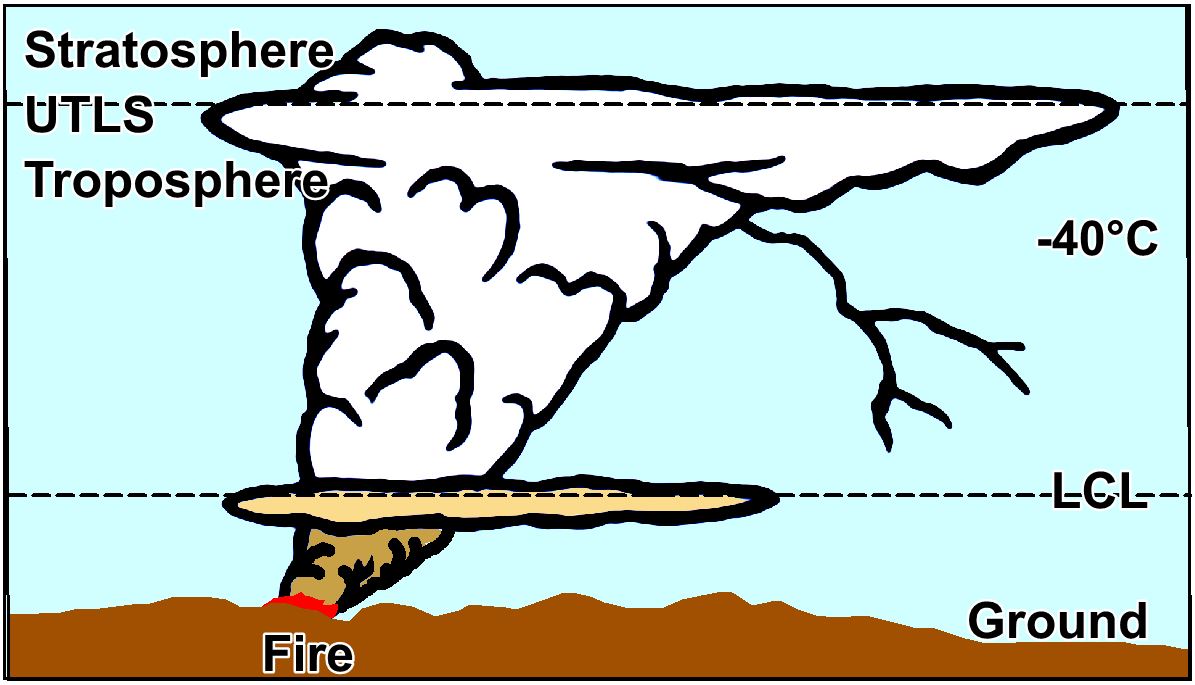


Types of PyroCb

Type U1a. PyroCb event

A pyroCb can occur when VPC production originates from a limited area, typically less than 50km, linked to a single or multiple overlapping BUFEs. This is likely to be from a single fire or fire complex, and likely from a single Division. After initiation, the BUFE typically lasts for up to three hours. The affected Division should be treated as dangerous for fire crews for, nominally, three hours, with continuing re-assessment of the fire-ground risk profile.

Type U1b. PyroCb cluster

Here VPC initiation spans a broader area, typically involving multiple fires in a limited area, a fire complex, or more than, indicatively, 50km across a fire-affected area. VPC production does not exceed the lifetime of the underlying BUFE event, typically 2 to 3 hours.
On a landscape with multiple fires, or fire complexes, conditions amenable to BUFEs may occur nearly simultaneously on more than one fire. This reflects the spacing of fires across the landscape, and often shows passage of a trough, wind change event, or the sudden removal of a convective cap (such as by the removal of dense smoke by a wind change).
All sectors and divisions of all fires involved should be treated as dangerous for fire crews for a minimum of three hours, with continuing re-assessment of the fire-ground risk profile. Affected and nearby Incident Management Teams need to coordinate their assessments.

Type U1c. PyroCb Pulse

Here VPC production originates from a limited area, typically a single fire, part of a fire complex or a span of less than, indicatively, 50km in a fire-affected area. VPC production exceeds the lifetime of a typical BUFE event, typically 2 to 3 hours. (This does not apply if the underlying fire significantly abates.)
A dangerous fire can produce a series of pyroCbs from a common source area, the extent of which reflects the rate of expansion of the fire. The cause of this “cycling” has proven difficult to ascertain, but may be due to terrain patterns or to unstable feedback loops between the fire and its environment. Some or all pulses are pyroCbs, some may be Sub-UTLS events.
Pulses act to extend the window of dangerous conditions beyond those of single pyroCb events – perhaps for an entire shift – requiring continuing re-assessment of the fire-ground risk profile.

Type U1d. PyroCb outbreak

Here VPC initiation spans between, indicatively, 50 km to 200km typically involving multiple fires in a limited area (often a fire complex) or less than 24 hours. An outbreak of pyroCbs involves a series of pulses from a cluster (i.e. spanning more than the duration of a typical BUFE, 2 to 3 hours, and more than 50km). General fire intensity does not abate for that duration. Not all events in a cluster need to pulse.
All sectors and divisions of all fires involved should be continually re-assessed for danger to fire crews, with changes to incident objectives implemented as and when required.

Type U1e. PyroCb super outbreak

Here VPC initiation spans more than, indicatively, 200km and one day. This somewhat arbitrary term has been applied to a single event (in southeast Australia between 28 December 2019 and 4 January 2020) when regional conditions amenable to large numbers of BUFEs occurred over a number of days. This was associated with branched inshore troughs ahead of a stalled cold front. A long-lived low-pressure recirculation formed, keeping fire behaviour elevated.
All sectors and divisions of all fires involved should be continually re-assessed for danger to fire crews, with changes to incident objectives implemented as and when required. This need carries over between shift cycles. The conditions involved mandate specialist meteorology advice, a specialist intelligence cell, and a dedicated remote sensing group. It is expected that future events (under the influence of climate change) could radically alter this definition.


INDEX TO TYPES

Type S1: Smoke shield
Type S2: Smoke shield with rebound
Type S3: Smoke shield with towering pyroCb
Type U1: Sub_UTLS event
Type U2: PyroCb
Type U3: Pyro-puff (towering pyroCu)
Type U4: Fire enhanced ambient Cb event
Non-VPC fire