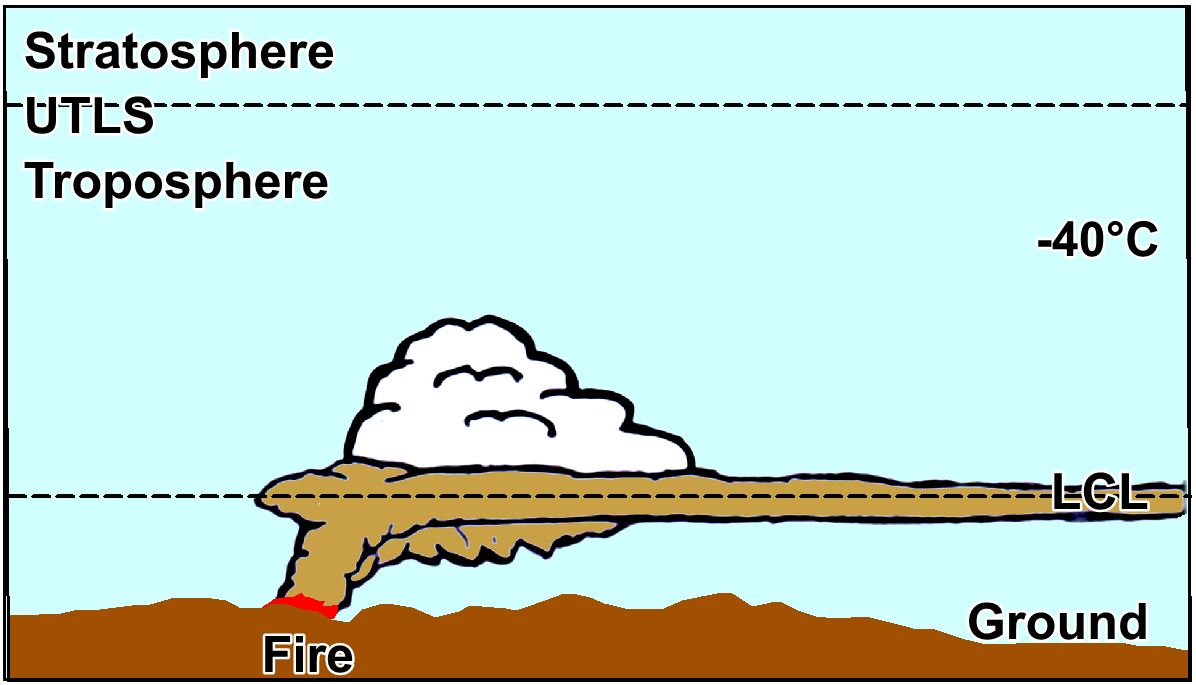
Type S2. Smoke shield with rebound
If the profile has a very strong convective cap, between roughly 8° to 10°C, short-lived towering pyroCu are likely to be present. Overall, the plume cannot pass the cap, but its core does initially push past, forming a towering pyroCu. Once initial upward momentum and the effect of latent heat of condensation dissipates this subsides back to the smoke shield, with the cloud evaporating. After that, the plume spreads out sideways as it advects away from the fire. There are indications of the potential for a downburst, not necessarily aligned with the prevailing winds (rather reflecting the balance between the wind vectors and outwards plume spread vectors). There can be some immediate downwash of large aerosol.A key safety concern arises if the fire is on high ground, closer to the LCL, as the downburst can rapidly push fire downslope, with the potential to cross containment efforts.