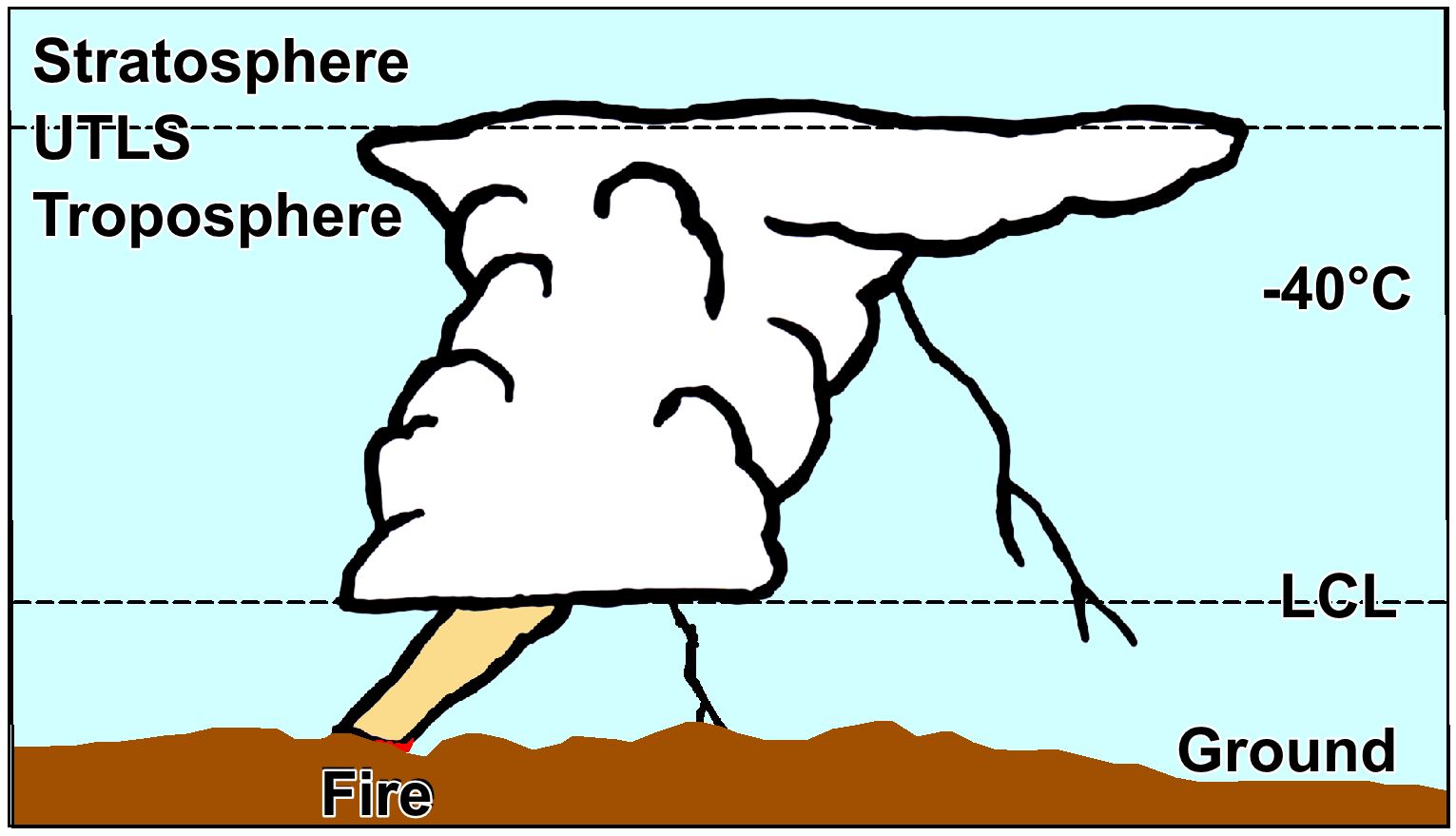
Type U4. Fire-enhanced ambient Cb
If Cbs occur, or are about to occur within (typically) 50km of the fire ground, the smoke plume can then be entrained into a Cb’s inflow.BUFEs are commonly linked to trough lines, as are Cbs – so it is not unexpected that in some cases there is an ambiguity between a Cb or pyroCb label. Evidence suggests that North American pyroCbs occur preferentially in conditions conducive to Cbs, whereas there is no evidence for this in Australia.
Ambient Cbs lack the abundant condensation nuclei that make pyroCbs so distinctive. Satellite imagery can help distinguish them – if the anvil has a cloud-top infraredBrightness Temperature (BT) anomaly, or is discoloured by aerosol, then it is part of a pyroCb (see above).
Beyond the normal fire-ground safety issues from Cbs, there is some evidence that extra care is needed on the fireground as fire behaviour may be directly affected by these events.